
The health department in the Western Cape is partnering with farms in the Cape Winelands to provide easier access to healthcare for farm workers. Spotlight unpacks one such partnership and why it is a triple win for workers, businesses and the government.
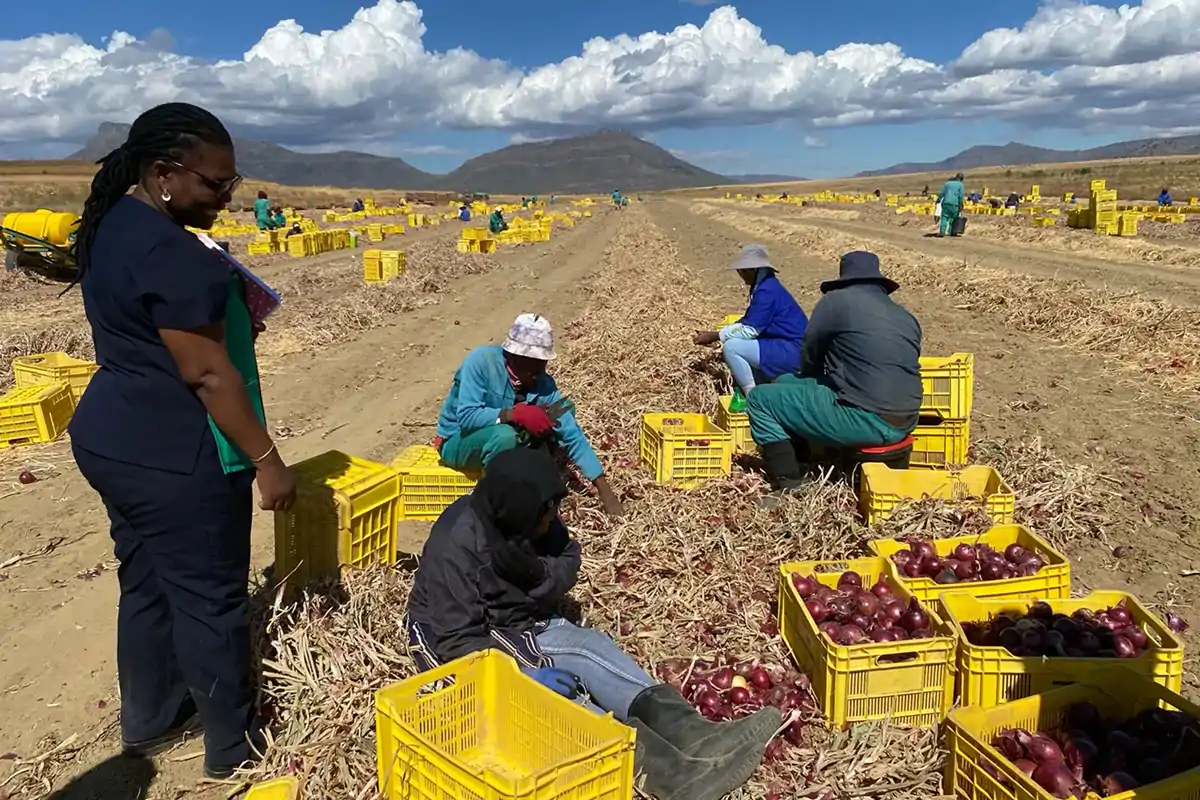
It’s a sweltering January afternoon on the Kromfontein farm in the Koue Bokkeveld, north of Ceres in the Western Cape. At least a hundred farm workers are busy harvesting red onions in a vast field, with the rugged Cederberg mountains as a backdrop.
A quiet stillness hangs over the fields. Workers are covered from top to toe to protect themselves from the sun as they fill the yellow crates with freshly picked red bulbs. Not far from where they are harvesting is a water truck, where the workers can go to cool down and rehydrate.
As they work, a bakkie rolls up with two community health workers who walk onto the field. Annah Khontsiwe and June Jantjies are from Kromfontein farm’s clinic. They are based there as part of a unique initiative between Dutoit Agri and the Western Cape Department of Health and Wellness. Through this partnership, clinics have been set up on their farms in line with the department’s focus on place-based care. This system makes healthcare significantly more accessible for workers who once needed to travel long distances and miss work to visit a clinic.
Dutoit Agri has 11 clinics on their Western Cape farms and packhouses, employing 14 community health workers, all overseen by four clinical nurse practitioners. The figures speak for themselves. “From January to December 2025, our Western Cape farm health workers saw 18 545 people and the sisters saw 16 959,” says Mariette le Roux, who coordinates healthcare services for Dutoit Agri.
Read the full article on the Spotlight website and a related article on Food For Mzansi.